ANI
05 Jun 2026, 05:59 GMT+10
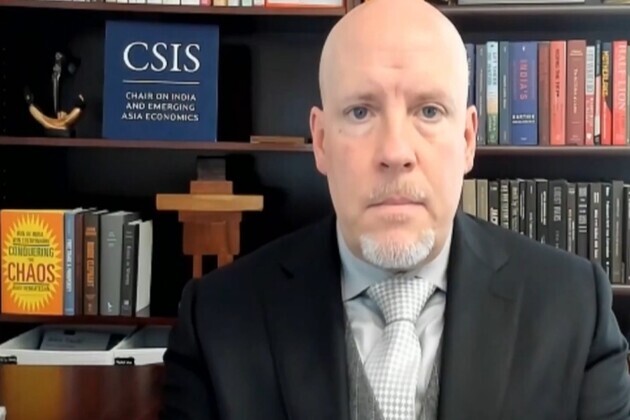
Washington DC [US], June 5 (ANI): Senior Adviser and Chair on India and Emerging Asia Economics at the Centre for Strategic and International Studies (CSIS), Richard M Rossow, said the US's tariff approach looks 'wobbly' to a lot of our partners.
'Some of the tariff lashes have been applied globally or to large groups of countries. Probably the only area of very specific exception was the original Russia oil-related tariffs that hit India particularly hard... India has a lot of non-tariff barriers: quality control orders and price controls and domestic manufacturing mandates. So the President's inclination to try to get a little more parity in how we approach friends on trade, he wasn't wrong. Just this kind of approach and using tools that couldn't stand up in court has made the U.S. approach look wobbly to a lot of our partners. But I think quietly, a lot of people kind of agree that the President is not wrong with the idea...,' Rossow told ANI while sharing his views on US's tariff approach to India.
'...From my own conversation with Indian officials across the last six months or so. The big question in the Indian negotiator's mind is where is the US tariff authority gonna land? Again, we've seen the President attempt to use two different authorities, both of which were struck down by courts, imposing tariffs specifically on India for Russian oil. That's been postponed and held in abeyance, maybe reintroduced. You've got a lot of things that are juggling right now...What india wants to see first and foremost is some level of stability...,' he further said.
Rossow believed that India came out pretty early, describing some real bright lines, 'When you talk about basic agriculture in India, farmers don't have a lot of fallback opportunities and, a lot of small farmers in India have no hope of accessing US, whereas U.S. agriculture is purpose-built for being able to send a lot of produce overseas... The US took a little longer for that to sink in and we still don't know whether the President will accept an agreement that still carves out lots of basic areas of agriculture, the staple grains that are grown by the common man in India... I think both of them (India and US) have their own kind of approach in thinking about this... I think it was the US, for some time, because we were pushing for things India couldn't give, but now it seems that India is probably slow walking a bit more because they don't know what US tariff authority looks like...'
On Tuesday (local time), the United States announced a fresh slew of additional tariffs of 10 per cent and an additional duty of 12.5 per cent on key global economies, claiming that investigations have revealed goods being imported from 60 countries are produced via forced labour.
The Office of the United States Trade Representative (USTR) listed 54 economies including India-- which it claimed have failed to impose and effectively enforce a prohibition on the importation of goods produced with forced labour. The list includes countries such as Australia, China, India, Israel, Japan, Qatar, and Russia. Other countries listed included Saudi Arabia, Singapore, South Korea, Sri Lanka; Switzerland, Taiwan, Thailand, Turkiye UAE, the United Kingdom.
According to the USTR, economies that already have some form of forced labour import prohibition, or have committed to implementing such measures through trade agreements, could face an additional tariff of 10 per cent. Other economies may face a 12.5 per cent additional duty.
The proposed action also includes a textile mechanism that would allow a certain volume of apparel and textile imports from some economies to enter the US at a reduced Section 301 tariff rate.
As per the USTR, the action comes under Section 301 of the Trade Act of 1974, which allows measures to be taken over 60 economies over their acts, policies and practices related to the failure to what it called impose and prohibit goods produced with forced labour--calling it unreasonable and a burden on US commerce.
The USTR flagged 6 economies for having failed to effectively enforce a prohibition on the importation of goods produced with forced labour. These include the European Union, Pakistan and Canada. (ANI)
Get a daily dose of Maryland Leader news through our daily email, its complimentary and keeps you fully up to date with world and business news as well.
Publish news of your business, community or sports group, personnel appointments, major event and more by submitting a news release to Maryland Leader.
More InformationWASHINGTON, D.C.: The Trump administration this week imposed sanctions on Iran's largest digital asset exchange and three other cryptocurrency...
TOKYO, Japan: Severe tropical storm Jangmi hit Japan on June 3, bringing strong winds and heavy rain that disrupted transport and businesses...
BELFAST, Northern Ireland: A man who pretended to be live-streaming a video game on YouTube to create an alibi while he killed his...
KHARTOUM, Sudan: The United Nations says sexual violence has become one of the main features of the war in Sudan, which is now in its...
GENEVA, Switzerland: The United Nations weather agency said on June 2 that a moderate or possibly strong El Niño could develop, which...
GENEVA, Switzerland: Global health organization CEPI has committed roughly $60 million to accelerate the development of vaccines against...
NEW YORK, New York - U.S. stocks closed sharply higher on Thursday, led by a blockbuster rally in the Dow Jones Industrial Average,...
NEW YORK CITY, New York: Elon Musk's SpaceX is planning an unprecedented stock market debut, aiming to raise a record US$75 billion...
SAN FRANCISCO, California: Microsoft said it expects to have commercially useful quantum computers by 2029 after unveiling a new quantum...
LONDON, U.K.: Nigeria's Dangote refinery has built up a significant surplus of jet fuel and is well-positioned to supply markets around...
NEW YORK, New York - Wall Street suffered a dramatic sell-off on Wednesday as a new outbreak of hostilities in the U.S.-Iran conflict...
WASHINGTON, D.C.: U.S. job openings rose unexpectedly in April, reaching their highest level in nearly a year, but economists cautioned...